The Sanctuary called Ramadan
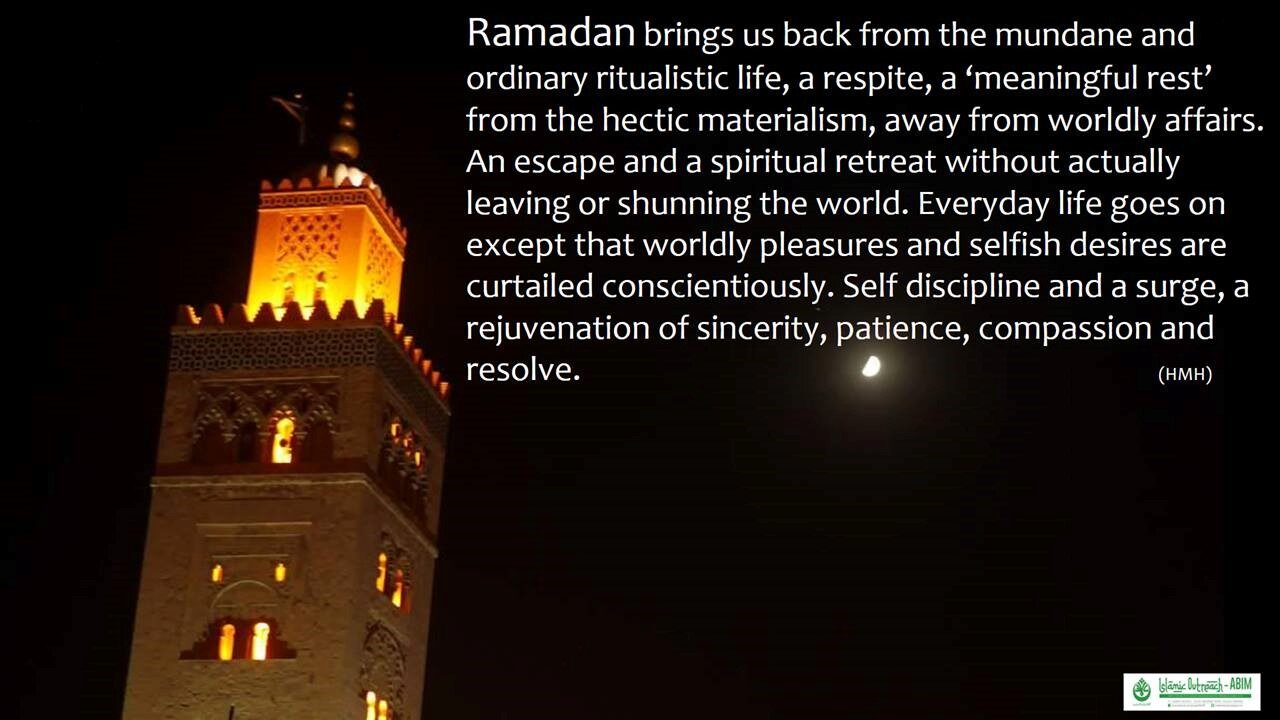
Ramadan brings us back from the mundane and the ordinary ritualistic life, a respite, a ‘meaningful rest’ from the hectic materialism, away from worldly affairs. It is an escape and a spiritual retreat but without actually leaving or shunning the world. Everyday life goes on except that worldly pleasures and selfish desires are curtailed conscientiously. Self discipline suddenly then becomes a normal way of life. There seems to be a surge, a rejuvenation of sincerity, patience, compassion and resolve.
How can this be so? For one thing, the evil Syaitan, our arch enemy is actually or metaphorically out of the picture, being restrained from bothering mankind for the rest of the sacred month. Then, there are blessings which grace forgiveness, multiple and abundant increase in rewards for good deeds and performance of ibadah – worship, conflagration of awareness, self reflection and internal motivation as well as the feeling of community togetherness in a unison of faith and piety to Allah almighty.
Ramadan is a religious sanctuary, a spiritual haven, without having to migrate or to travel far away. We need not leave our troubles behind. No, instead, it is Ramadan which replenishes our soul, our inner self, our natural being, our fitrah –our inherent and innate nature – to come back stronger than ever in faith, in character and in good deeds. With faith, with taqwa – God conscientiousness, with much stronger will power, boosting our inner strengths, we shall overcome our concerns and anxieties. By fasting and observing all the enjoined activities, the obligatory and the supererogatory; our nafs, our self returns to a more purified state. Fasting imbues in us, trains us, disciplines us to be spiritually enlightened throughout night and day, to be in constant awareness, in deep remembrance, contemplating, reflecting, accumulating good deeds, rewards and achieving the ultimate goal of taqwa, the highest form of God consciousness.
Yes, we do indeed face tribulations, personally and as a nation, as an ummah. Now the whole world is facing one of its biggest calamities, a lethal pandemic which affects everyone. We are forced to isolate ourselves and stay in seclusion. Ramadan this year will not be the same. The present and impending catastrophe as a consequence of the pandemic is in the form of social problems and the severe effects of economic recession that will hit the weakest the hardest. This is Allah’s test. This adverse challenge requires strong faith, endurance and mujahaddah – striving and struggling in upholding Islamic principles, seeking a thorough solution, a way out of the crisis and, saving people and caring for the people – ensuring the dignity and integrity of the Muslim community. This requires the unity of the community and the kindest brotherhood with the rich helping the poor, the better off helping those in difficulty, the healthy helping the sick. One of the lessons and wisdom of Ramadan is to remind Muslims to feel the suffering of the poor, the deprived; reflecting , appraising and acting on them. It teaches us to be grateful to Allah s.w.t. for His bounty, His grace that we be generous with what is bestowed upon us; what we treasure most to be made available in His service and to give, to be charitable, to donate, to contribute to help others in need. We must always remember the suffering of the oppressed. Fasting brings such awareness and awakens us to the bitter realities that requires reform, rejuvenation, courage and compassion to bind us together to face the challenges ahead.
Even in times of calamity, the sparkle of Ramadan, the surge in remembrance and the height of taqwa shall be triumphant and shall prevail. Even if sadly, we will not be able to gather and congregate in our masjids. The people of faith cherish and treasure truth and are very lovingly jealous of the deen – religion of Islam. How they treasure performing solat together tightly filling the rows. No one shall be able to treat it lightly. Yes there were people in the past and there maybe some too at present who wish to regard lightly of Ramadan and of the associated spiritual activities. Some just carry on as usual, conducting some mundane activities at whatever time of day, even though, it is better and proper to prize and revere the limited time available to perform tarawih – night prayers or the recite the Quran and experience more of the spiritual pleasures and significance of fasting. Some only wish to observe the fast and the breaking of the fast, relegating it just to a time table shift in daily affairs. There are many in this world who still let the Night of Power just pass by without feeling any loss or even realizing its existence or significance altogether.
This Ramadan may not be as normal as before and requires adjustments. It is hoped that with a community wide consciousness, counsel, close support and exhortations from family and friends, that this time, we shall overcome with the help of Allah s.w.t. and to Him only we seek help, we perform the utmost in our fasting and observance of Ramadan so that we shall attain the highest level of taqwa.
ISLAMIC OUTREACH ABIM PENANG
The Higher Objectives of Fasting: Wisdom and Purpose of Its Decree
By Dr. Siddiq Fadzil
In his book Maqasid al Sawm, Sheikh ‘Izz al-Din Ibn’ Abd al-Salam al-Sulami al-Shafi’i presents a part of the great framework of the higher objectives of shari’ah– maqasid al-shari`ah which covers maqasid al-`ammah (general objectives), al-maqasid al-khassah (specific objectives) and al-maqasid al-juz’iyyah (partial particular objectives).
The term al-maqasid al-juz’iiyah refers to the reasoning (`illah ), wisdom and purpose behind a law. Indeed every law of shari’ah contains wisdom and purpose, either expressed or implied.
Allah the Almighty the Most Wise, commands and ordains with purpose. That is the case with fasting, which is clearly aimed at achieving various benefits and spiritual accomplishments formulated in that astounding word, taqwa.
What is required in fasting (and other rituals of worship), is not only the implementation of the requirements and the tenets, but also the achievement of wisdom and purpose.
Al-Shaykh al-`Izz (`Izz al-din) ibn` Abd al-Salam (578 – 660H) was able to envisage and illuminate the fact that holistically, shari’ah is the realization of maslahah (benefit and goodness for mankind).
This is revealed clearly and firmly in his work, Qāh`id al-Ahkam fi Masalih al-Anam. The title of this work alone implies his thinking, in linking the law and public concerns – higher human interest.
In his great work al-`Izz says that the shari’ah as a whole is geared up towards either avoiding evil or bringing about goodness.
Hence, for every divine call in the Qur’an, “O you who believe, …”, it is certain that the next message certainly about extolling the good to be gained or the evil disadvantages to be avoided.
Thus the verse which obligates fasting (al-Baqarah: 183) also begins with the call, “O believers, …”. The message that follows is the way towards attaining taqwa, the peak of goodness that must be achieved by fasting.
In the discussion of the division (types) of maqasid al-shari`ah there is a category called maqasid ta`abbudiy or the divine goal of worship.
As mentioned in surah al-Dhariyat: 56, the purpose in the creation of jinn and humans is to submit themselves to worship and devote themselves only to Allah.
Indeed, the mission of human life is total devotion to the Creator and, to administer and care for His creatures (`ibadat al-khaliq wa islah al-makhluq ). Serving God means obeying His commandments and obeying His will. For that purpose, mankind must escape the shackles of lust and selfish desires.
This maqasid or objective is emphasized by Shaykh al-Maqasid al-Imam al-Shatibiy in his monumental masterpiece of al-Muwafaqat that states, “The purpose of the shari’ah is to liberate people from the inclination and impulse of selfish desires (… ikhraj al-mukallaf min daa`iyati air ) “.
Thus, objectives of shari’ah in worship covers the goal of human liberation from serving his lusts, or be free from making his desires as his god.
Throughout the month of Ramadhan, the believer struggles to achieve this objective of shari’ah, “liberation from the manacles of desires”. The fight against the self is mentioned in religious language as mujahadah. The word mujahadah is a form of a word with the same roots as jihad , to strive and fight to the utmost for a noble cause.
But mujahadah means continuous and repeated spiritual struggles. Indeed, though lust can be defeated by mujahadah, however it will rise and rise again despite the many number of times it is defeated.
Therefore, the fight against the self must also be continuous and steadfast. Importantly, fasting gives us the confidence and conviction that we are actually able to defeat lust.
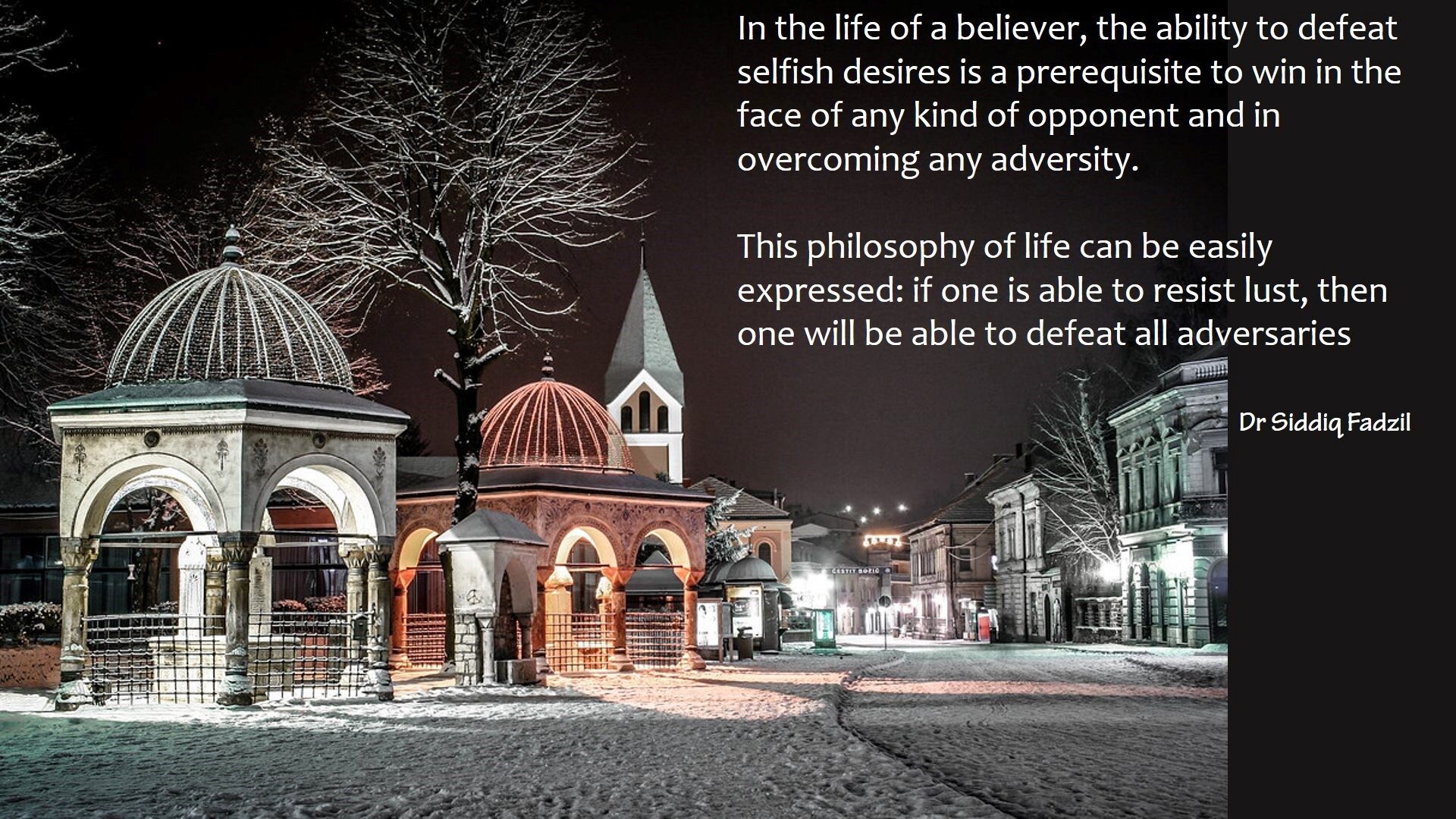
In the life of a believer, the ability to defeat selfish desires is a prerequisite to win in the face of any kind of opponent and in overcoming any adversity.
This philosophy of life can be easily expressed: if one is able to resist lust, then one will be able to defeat all adversaries; On the contrary, if you fail to defeat your selfish desires, you will not be able to withstand all others.
Knowledge of the aims of the fasting (maqasid al-sawm) will certainly help improve the quality of worship. Our fast will be more meaningful and effective, and we will not just be experiencing hunger and thirst.
Fasting is a worship and at the same time it trains and develops the formation of a character of taqwa. The characteristics of the God Conscious ( al-muttaqin) are widely expressed in the Qur’an.
The word taqwa itself is defined by some scholars as vigilant consciousness and inner alertness raised by the fear of Allah, hope for His forgiveness and the love for Allah.
The actualization of a personality of taqwa is part of the objectives of Shari’ah , especially to establish good morals as Prophet Muhammad ﷺ said, “Verily I am sent to perfect noble characters”.
Worship (including fasting) is generally a matter of morality, in the sense of being devoted and obedient to God.
Fasting is a deed of worship with the wisdom of moral education and manners. Hence, those who are fasting are bound by a number of moral taboos as discussed in the fasting rituals.
Therefore it is necessary to be governed not only by the legal, permissible and impermissible aspects of the fiqh – the established rules, but also the aspects of morals, manners, the essence and the spirit of fasting.
Hopefully our fast in Ramadhan this time around shall be better than it ever was in the past. Welcome to Ramadhan’s rigorous celebration of intensive worship in order to attain taqwa , God consciousness, achieve the purpose of fasting thereby realizing the objectives and intentions of the Shari’ah.
(Introduction by Dr Siddiq Fadzil to the Malay translation of Sheikh ‘Izz al-Din Ibn’ Abd al-Salam al-Sulami al-Shafi’i’s book, Maqasid al Sawm by published by Institut Darul Ehsan) (This is an English rendition)
ISLAMIC OUTREACH ABIM PENANG
Ramadan and Convergence of the Ummah
Ramadan is a month of learning, a month of self reflection and contemplation, taking stock of one’s journey through life in the company of the Highest Order of universal society. It is the month for the commemoration and celebration of the Al Qur’an. It is surely a festival of taqwa.
All over the world, Muslims greet its coming with happiness, gladness and as if it was a long lost companion who has returned showering gifts. While at the month’s end, although parting with it saddens feelings, as if it was over too soon, Muslims feel a sense of achieving glowing success. Indeed at the end of Ramadan they experience joy and feel victorious. They overcome their own selves and desires to return to their true and natural God given state, their fitrah, pure in true worship and submission to Allah s.w.t.
Ramadan is indeed very special and tremendously invigorating for the Muslim community. Muslims await dearly for the arrival of the blessed month. Disputes may arise as when to begin, when to exactly start fasting, how to determine the awaited new crescent, hilal, but this soon diminishes as people understand the importance of principles over the trivialities and by prioritising the major essentials of worship. The most important of all, is unity of brotherhood and purposefulness.
This Ramadan there may be no bazaars like before that add to the colour and excitement. Businesses will lose the booming Ramadan trade which thrives catering to one’s self indulgence and hungry cravings of the day. This pandemic has dramatically changed our usual social activities, in a particular way, reminding us of the message of taqwa and God consciousness that Ramadan arouses in people.
Ramadan is a special and blessed month in honouring and venerating the anniversary of the message of tawhid, the start of the revelations, the nuzul al Qur’an. It is a grand celebration in its own unique Islamic way that the ummah is one, that the Qur’an is guidance from God Almighty, bringing proof of guidance and is the criterion between truth and falsehood, differentiating right from wrong.
The meaning of it all is tawhid – to invite all of mankind to sincerely and truly worship only Allah s.w.t. and that there is none other to be worshipped except Him. This is sincerity and purity of intention.
There was the story of the experience of a new convert to Islam who was starting her first ever fast during Ramadan. She was quite surprised to discover that Muslims really did fast meaning that they did abstain from food and drink for the whole day and it was not something that was made up. Fasting proves and motivates Muslims to show that sincerity and God consciousness – ikhlas and taqwa are qualities that are really quite attainable.
No matter what methods are used to tell the time for Ramadan activities, to signal its arrival, whether sirens, drum beats, cannon shots or just the call to prayers, adhan , the Muslim community communicates in all of these in their own special way. They become especially time-conscious during Ramadan.
The community wakes up much earlier than usual for early supper, sahur. By being awake early in the wee hours of the night, it enables them to engage in night vigil, qiam al layl, performing solat tahajjud – late night prayers, reading the Qur’an, dhikr and doa – remembrance of God and prayers, contemplating their deeds and efforts. The family is gathered together even in their tired and sleepy mode to have supper before dawn. Just by having sahur contains blessings and rewards beyond our comprehension. Muslims then work their day without food and water. They do not use fasting as a reason to shirk their duties or find something lighter to do. They try even to abstain from all acts deemed against the blessedness of Ramadan. They refrain from doing anything evil: being dishonest, telling lies, backbite, argue insensibly and at the most ideal level, to desist from even having a dark or bad thought in one’s heart or mind for those who aspire for a perfect fast. At dusk, they gather and celebrate daily together in breaking their fast, iftar. A short doa is recited to be thankful and grateful to Allah s.w.t. who enjoined fasting, provided them their boundless bounties and grace, rizq and made them Muslims. Then they pray solat Maghrib, have a short rest and go on to perform Isya’ followed by solat tarawih. This Ramadan however, whole families will not be able to throng to line up the rows to fill the saf in the musalla and the masjid – mosques.
Pity the children who normally play and have plenty of fun in the masjid or musalla compound and grounds. For It seems only in Ramadan where children are usually permitted to be out at night within their parents’ supervision. There seems to be a sense of security even at night. Like the anecdote which says, “Ramadan’s coming. Hey! Look who’s leaving”. It is said that the doors of heaven are opened wide while the doors of hell are closed shut and Satan is kept in chains. However this Ramadan everyone stays home and shall have to make the necessary adjustments to make it a wonderful and holy month.
In previous Ramadan, some families even rule out TV for the whole month but this needs some persuading and consensus building as whole families see the TV as the only means to reach the outside world during in these troubled days of ‘lockdowns’. Family members have to work it out among themselves in order to create serenity and an appreciation of the calmness of the night and to enable them to do something more useful for Ramadan, to make it a better Ramadan than in previous years.
The following may be missed this Ramadan. Muslim communities which engage in communal iftar, tarawih, tadarrus – Qur’an recitation circles and other shared activities, cheerful and vibrant scenes with a sense of purpose in worship. A unison of cooperation and togetherness unmatched by any other month. We may miss this.
However, if we accept and adapt to the new normal, we can still hear the rotational Qu’ran recitals, tadarrus participants humming and enchanting the hallways, echoing in in Muslim homes. Late night and early morning prayers lit up houses, nights are alive with remembrance and grace.
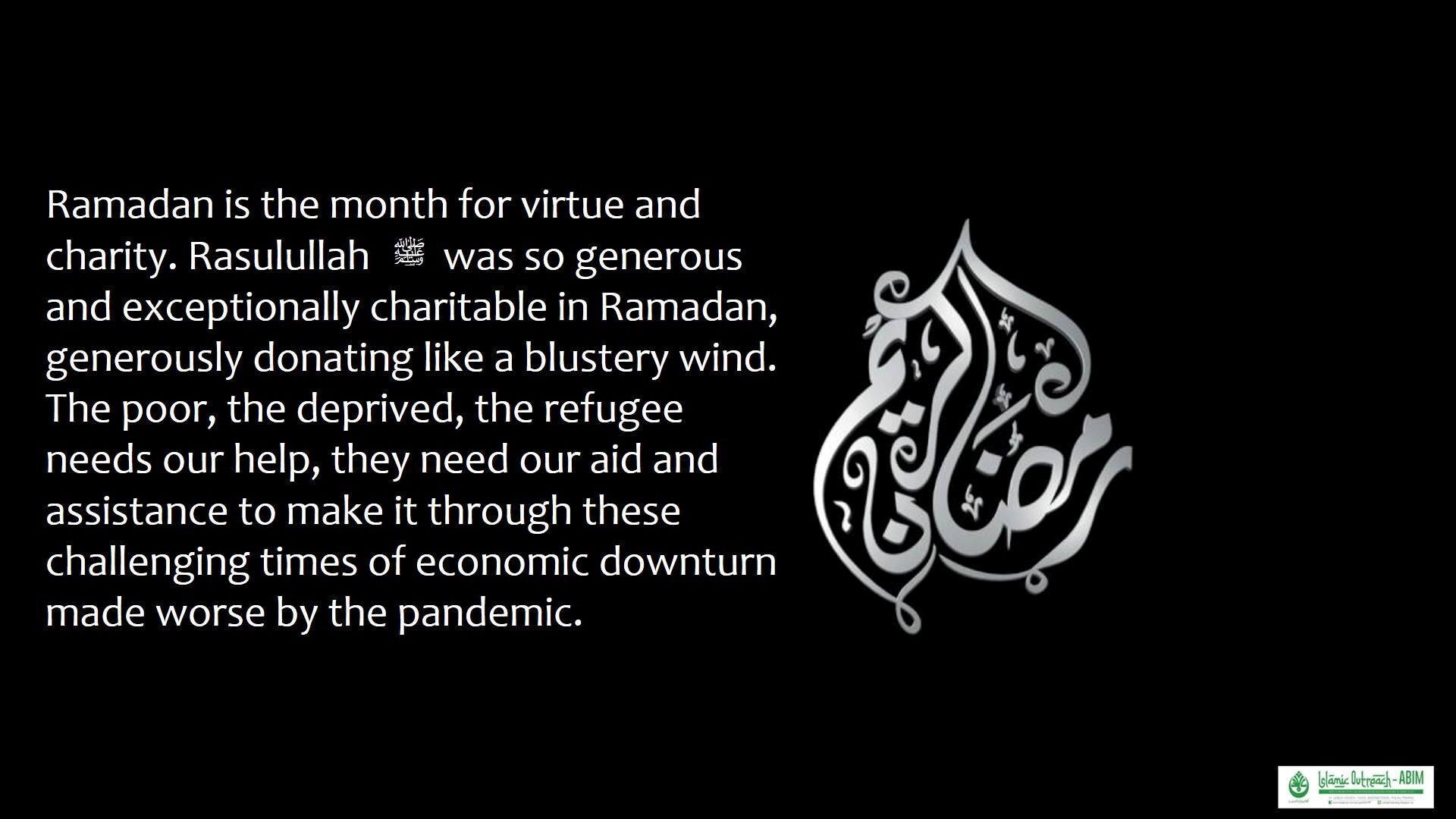
Ramadan is the month for virtue and charity. Rasulullah ﷺ was so generous and exceptionally charitable in Ramadan that the companions described it as if it was like a fast and blustery wind blowing through, giving as much to as many. Offering iftar or breaking of fast to others especially the needy is considered as great as fasting itself. In times of dire needs and miserable conditions of some of Muslims worldwide, the ummah needs to be imbued with more generosity and abundant charity, encouraging it to be managed more effectively and be more organised. Zakat ul fitrah institutionalises a certain form of alms-giving to be obligatory– to help the poor, to share with them to help them celebrate together with the ummah. The poor, the deprived, the refugee needs our help, they need our aid and assistance to make it through these challenging times of economic downturn made worse by the pandemic and emergency measures to contain the contagion.
Sayyid Qutb writes on laylatul qadr, describing the Night of Power as the night which marked the beginning of the revelation of the Qur’an to Muhammad ﷺ, an event unparalleled in the history of mankind. The revelations and the assigning of the message to the Prophet s.a.w. is the greatest and most precious of events. The angels descend, led by Jibril by their Lord’s permission to fill the space between heaven and earth in such a glorious and splendid celebration, vividly portrayed in the Qur’an: surah al qadr. Humanity out of ignorance and misfortune may overlook the value and importance of laylatul qadr. When humanity ignores this, it loses the happiest and most beautiful sign of grace which Allah has bestowed upon it. Muslims are commanded not to forget or neglect this event. Rasulullah s.a.w. has thought them how easy and enjoyable it is to commemorate that night by being in devotion with pure motive of faith.
In the Qur’an, following the verse concerning fasting and Ramadan, Allah s.w.t. mentions how close He is to believers: Indeed it is a lofty declaration from the Most Highest the Most Exalted. Allah s.w.t. is close to them and Allah grants them their prayers to Him when they supplicate Him – when they humbly ask from Him. And so they must submit to His commands. Fasting and worship in Ramadan brings Muslims much closer to God Almighty.
For Muslims, the Qur’an is ample and perfectly equipped to withstand any test or tribulation of the times. The Qur’an remains steadfast in combating mischief and corruption even when society abdicates its moral authority. The guided shall neither be fooled nor intimidated by any evil. Through the Qur’an, the Sunnah and learning from their respected scholars, we remain on the true path.
So let’s pray and seek forgiveness and repentance as much as we can, especially during such a deeply worrying and agonizing situation right now. Try to seek forgiveness and repent as much as we can. Remember, Allah Almighty, will not forsake His promise not to punish His servants who are still in good faith, devotedly praying and seeking His forgiveness. To face this pandemic which is a test from Allah, Muslims have to strive to seek solutions, to find cures, to prevent its spread.
“The believers are amazing, everything works out well for them, and no one else is like the believer. When rewarded with pleasure he is grateful, and when disaster strikes, he is patient. This is what makes him to be always in goodness.”(Hadith narrated by Muslim)
It is hoped that this Ramadan becomes a convergence of the ummah to regain its true and proper position as the middle and upright community enjoining good, forbidding evil and inviting all towards belief and salvation.
Reference:
Animah Ferrar, Islam, Worldview and Way of Life
B Aisha Lemu, Islamic Aqidah and Fiqh
Hanafi Muhammad, 40 Fadhilat Puasa Ramadan – 40 Virtues of Ramadan
Ismail R Faruqi, The Cultural Atlas of Islam
Muhammad Ali Dannawi, Madrasah Ramadan, Penerokaan dan Hukum Hakam – Ramadan as an Academy, Exploration and Rules
Mustafa Masyhur, Bekalan di dalam Perjalanan Da’wah – Provisions in the Path of Da’wah
Sayyid Qutb, In the Shade of the Qur’an.
ISLAMIC OUTREACH ABIM PENANG